Friday, 25 August 2017
Mozes Mutungi (travel dairies): Tales of crossing the Kazinga channel on a leaking...
Mozes Mutungi (travel dairies): Tales of crossing the Kazinga channel on a leaking...: Tales of crossing the Kazinga channel on a leaking canoe manned by a drunkard I have been to Queen Elizabeth National Park for over 10 ...

Tales of crossing the Kazinga channel on a leaking canoe manned by
a drunkard
I have been to Queen Elizabeth National Park for over 10
times and usually I have never missed the boat cruise on the Kazinga channel,
for all this time I was sailing on an engine propelled boat manned by
experienced coxwines and a life jacket has been must before my cruise trip
starts. What makes the channel a must visit is the amazing but dangerous
aquatic inhabitants of the 32km long channel for example the channel has the
world’s largest concentration of hippos and numerous Nile crocodiles.
All that in my head I never knew that there is a human being
that would risk his or her life crossing the 10minutes channel ride to the other
end of the channel or I taking one of the riskiest return journeys of my life,
“crossing the channel to Kazinga village to and from on a leaking canoe” manned
by a drunk fisher man.
So as fate would have it, I had to collect some data about
the relationship between the community and park authorities in the conservation
of Queen Elizabeth national park and my case study was Kazinga village with
some classmates of mine. This is in real sense had seconded us to cruise to the
other end of the channel by all means, as a students who had just finished
campus, we had no money to book the more comfortable and secure UWA boat
condemning us to the more cheap but dangerous means.
THE JOURNEY

On that fateful day, we (3) woke up in the morning from the Mweya
hostels and we consulted a friend, ranger guide on which route we would use to
the docking area, where we are supposed to board to Kazinga village, we got the
directions though we all seemed not conversant with the route to down the
channel from the higher elevation of Mweya peninsula. We took on the journey by
foot but remember we were in the park with no guide, nor were we armed, the
most scary part of it was coming across fresh hippo dung in one of the small
paths we were using down the Kazinga channel, but that didn’t bother us either.
We sloped down up to the first open channel bank of the Kazinga channel but we
weren’t seeing anything like a canoe service, what was visible was the fishing
village some 400metres across the channel and two big hippos swimming near land
in the water. Still puzzled on what to do we spotted some people on an adjacent
open bank and we moved there and to our delight they were also waiting for an
approaching canoe with red writings “transport Kazinga”
The now transport operator Park and was delighted to meet us
and he quickly told us how he had crossed to and from another student some days
back for the same purpose. For a minute we felt at home as he also offered to
help and take us to the fishing village and guide us to the village chairmen
and the people at large. He quickly told us that the fare was 2000ugx for a one
way journey and the same for return which we found very cheap and we quickly
entered the canoe anxious to get to the other side.
TO KAZINGA

Boarding the canoe was one other hurdle, its team work every
one has to help each other in holding/balancing the canoe for everyone to
enter, then later balancing it but later off we went and we are on water and
the operator quickly starts telling us stories of how one of their friends was
eaten by a crocodile a few days back and all they could discover was one of his
legs. We started engaging him on how they manage to cross a highly infested
hippo channel with canoes every day but the guy was speaking with confidence
which at one time I thought it was because of the influence of alcohol which
was smelling all over the canoe on top of chewing herbs (amailungi) but in 10
minutes we were at the other side of the channel safe and sound and I whispered
to one of my friends that I think God still loves us.
We did our research for the next 3hours with the help of the
canoe rider now turned site guide. Though some of the members weren’t willing
to give us information we managed to get and fill all the questionnaires and it
was time to make our return journey back to the park side. The canoe operator bragging
around his fellows how he is nowadays high class because he transports university
students and high profile people than his peers, we took some few photos and he
later helped us board the canoe and of we went.
Every one of us would easily notice his braggery but no one
would talk because once we were on water he was the king; halfway the journey we
realized the was a crocodile watching all our movements in her territory and he
decided to tease us by leading the canoe near her and there was sudden dead
silence on the canoe, since we all feared telling him to stop risking our lives
but he again diverted to the seemingly right way. He started telling us stories
of how crocodiles can easily view something in water even in a two kilometers
long distance, at this time my heart was in overdrive and my only prayer was
reaching the bank safe. The boat was leaking and we had to keep on fetching out
water which my friends later found interesting and they even recorded a video
of me fetching the water out of the canoe until we arrived. I have done frightening
trips, activities, like zip lining, but that was adventurous, mind blowing, and
I would probably do it again but this time with my life jacket.

By Mozes Mutungi
Uganda’s best safari guide
Tuesday, 25 July 2017
QUEEN ELIZABETH NATIONAL PARK
03 DAYS 2NIGHTS
QUEEN ELIZABETH NATIONAL PARK SAFARI
Day 1:- Arrival at
Entebbe airport OR pick up from hotel in Kampala - drive to Queen
Elizabeth
Early morning you will be picked at your hotel and head of
the country, a stopover at kayabwe for a photo moment at the equator. Proceed to
mbarara in time for lunch at Agip motel, and proceed to Queen Elizabeth national
park arriving in the evening, for dinner and overnight at either Simba safari
lodge/Kasenyi safari camp/Mweya safari lodge.
.
Day 2:- Morning game
drive and afternoon boat cruise on Kazinga channel.
Wake up for an early morning game drive
northwards to the kasenyi plains for an amazing game drive where you stand
chances of seeing lions, leopards, hyenas, hippos a wide range of antelopes and
elephants. Return for lunch at the lodge and then at 2pm head for the afternoon
boat cruise at the kazinga channel an area rewarding for birdwatchers, and lots
of aquatic animals like hippos crocodiles, buffaloes on the edges of the
channel and many other animals. Dinner and overnight at either Simba safari
lodge/Kasenyi safari camp/Mweya safari lodge.
Day 3: Return back
to Kampala or depart at Entebbe airport
Wake up at leisure and head back to Kampala using the fort
portal route lunch enroute at gardens restaurant, proceed to Kampala you will
be dropped off at your hotel or airport.
END OF SAFARI
|
Accommodation Type
|
1 Pax
|
|
|
BUDGET
|
1071
|
|
|
MID RANGE
|
1120
|
|
|
LUXURY
|
1204
|
|
NB: PACKAGE INCLUDES.
ü Enroute lunches
ü Transport in a fueled 4WD station
safari vehicle
ü Full board accommodation as per the
journey plan
ü Park fees
ü Game drive
ü Boat cruise
The package
excludes all activities not mentioned in the itinerary, all expenses of
personal nature like telephone, cigar, laundry, tips to guides, visa, insurance
and any other programs not mentioned above.
Friday, 7 July 2017

The African finfoot is an aquatic bird from the family Heliornithidae. The species lives in the rivers and lakes of western, central, and southern Africa.The African finfoot is an underwater specialist with a long neck, a striking sharp beak, and bright red, lobed feet. The plumage varies by race, generally pale underneath and darker on top. The males are usually darker than the females. It superficially resembles South America's torrent duck.
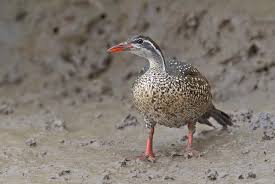

The African finfoot can be found in a range of habitats across Africa, where there are rivers, streams and lakes with good cover on the banks. This range includes forest, wooded savanna, flooded forest, and even mangrove swamps.
The finfoot feeds on aquatic invertebrates, including both adults and larval mayflies, dragonflies, crustaceans, also snails, fish and amphibians. They are thought to be highly opportunistic and take some of their prey directly off the waters surface. They are adept out of water and will forage on the banks as well, unlike the grebes, which they resemble but are not related to.
Finfoots are usually seen singly or in pairs. They are very secretive. Even experienced ornithologists see them very rarely, making them a prized sighting for birders and twitchers. Because they are so elusive, it is not known if they spend most of their time in the water, where they are almost always seen, or on land.
Their time of breeding varies by area, usually coinciding with the rainy season. They build a nest, nothing more than a mess of twigs and reeds, on a fallen tree above the water. Two eggs are laid and incubated solely by the female. The chicks leave the nest a few days after hatching. The African finfoot belongs to a family, Heliornithidae, whose only other members are the masked finfoot and the sungrebe. Their relationships between this family and other birds are poorly understood.
The African finfoot's conservation status is hard to determine, given its elusive nature. It is not considered threatened, as it is not persecuted or targeted by hunters, and while scarce, it is very widespread. However, there is concern that it may become threatened, as wetlands are cleared and watercourses altered and polluted. It is also thought to tolerate only minimal disturbance. This and increased habitat fragmentation mean that the species needs to be monitored to safeguard it. There are currently no African finfoots in captivity.
#30daysInthewild
Subscribe to:
Posts (Atom)
KAMPALA THE HILL OF THE IMPALA
KAMPALA THE HILL OF the IMPALA Kampala is the capital and largest city of Uganda . The city is divided into five boroughs that oversee l...

-
 KAMPALA THE HILL OF the IMPALA Kampala is the capital and largest city of Uganda . The city is divided into five boroughs that oversee l...
 -
Tales of crossing the Kazinga channel on a leaking canoe manned by a drunkard I have been to Queen Elizabeth National Park for over 10 ...